
Published: 28 February 2026 , NEWMAX
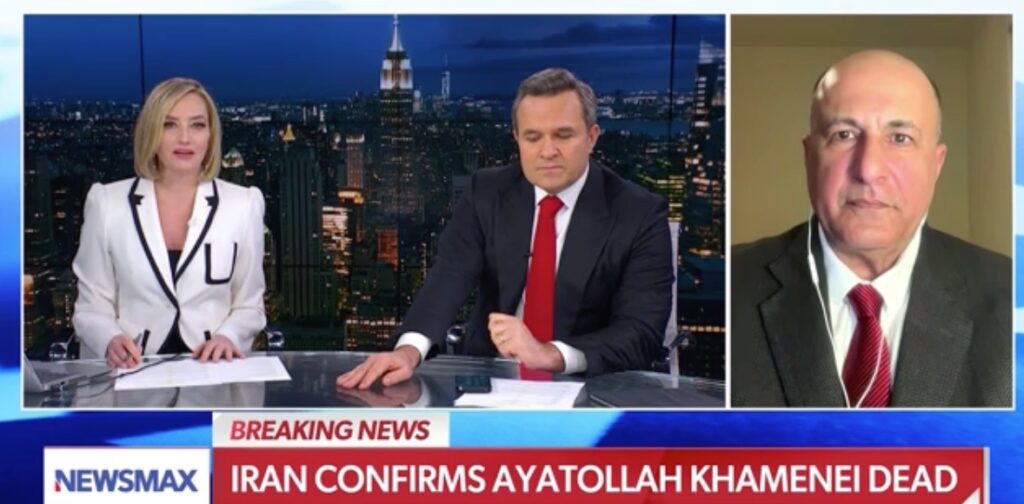
The elimination of Iran’s Ayatollah Ali Khamenei marks the most significant step toward potential regime change in Tehran, according to former Israeli Consul General Ido Aharoni.
Aharoni said the process of upheaval is likely already underway, though its outcome will depend heavily on whether Iran’s opposition can organize quickly and effectively enough to influence events.
“The main step on the road to regime change took place today,” Aharoni told Newsmax’s “Wise Guys With John Tabacco” Saturday, arguing that Khamenei’s removal creates a power vacuum at the heart of Iran’s highly centralized political system.
Khamenei, who ruled Iran for more than three decades, maintained strict control over the country’s political, military, and religious institutions.
Iranian state media confirmed his death early Sunday local time, throwing the future of the Islamic Republic into doubt and raising the risk of regional instability.
President Donald Trump announced the death hours earlier, saying it gave Iranians their “greatest chance” to “take back” their country.
State media reported that the 86-year-old was killed in an airstrike targeting his compound in downtown Tehran. Satellite photos from Airbus showed that the site was heavily bombed.
Aharoni described Khamenei’s leadership as authoritarian, saying the supreme leader governed “with an iron fist,” overseeing crackdowns that he said resulted in the deaths of tens of thousands of Iranians, including during recent unrest.
With Khamenei gone, Aharoni said he expects the system he tightly controlled to be in “complete disarray,” at least in the short term.
He predicted two parallel developments in the days and weeks ahead: an internal succession struggle among senior regime figures and a renewed push by opposition forces seeking to capitalize on the uncertainty.
“There’s going to be a succession struggle with people around him trying to take over,” Aharoni said.
At the same time, he added, opposition groups inside and outside Iran will likely attempt to coordinate efforts to challenge the ruling establishment.
Whether those opposition elements are sufficiently organized remains an open question.
Aharoni said the effectiveness of any challenge to the regime will hinge on its ability to unify and act swiftly during what he called a “very critical moment” in Iran’s history.
The implications extend beyond Iran’s borders, he said, describing the situation as equally pivotal for the broader Middle East.
Despite the dramatic shift, Aharoni cautioned that meaningful political change would not come overnight.
Even with Khamenei’s elimination, he said, dismantling entrenched power structures built over decades would be a “very long journey.”
As Iran enters a period of uncertainty, regional governments and global powers are closely watching how the leadership vacuum unfolds — and whether the moment leads to reform, renewed repression, or deeper instability.
The attack on Iran by the U.S. and Israel opened a stunning new chapter in U.S. intervention in Iran and carries the potential for retaliatory violence and a wider war.